When I Upload a Video in Premiere the Video Lags From the Audio
We've all been at that place before; the network goes downwardly, your workstation won't boot, or your NLE of selection crashes every fourth dimension you right-click, and all of a sudden your workday comes to a screeching halt. Or at the least, Premiere Pro's playback gets choppy and stuttery. And if this hasn't happened to yous, it'due south coming.
Engineering science, like people, has bad days from fourth dimension to time. Specially for united states in the post-production world, this inevitably seems to happen at the tail-cease of a projection when everything is due for delivery. That's certainly my experience.
Then even though troubleshooting a printer is not something most editors are prepared for, troubleshooting NLE bug is something we should all do. Because when y'all're two days from customer review, the last thing yous need is to waste hours browsing old forum posts for technical help. So allow's learn to take charge of our tools.
In today's commodity, I'll walk through some common issues and solutions in Adobe Premiere Pro and show you how to fix them. If you lot've ever experienced playback problems, export errors, or irregular performance, hopefully this guide volition spare you future frustration, and get you on the right path to NLE creative harmony.
Earlier We Start, Restart
Information technology may seem trivial, but sometimes Premiere Pro or your auto just needs a fresh start. Complex software similar NLEs tie up vast organisation resources, including the CPU, retentiveness, storage, GPUs, and network bandwidth, which tin can naturally cause a performance hitting and inclement playback performance after long editing sessions.
Simply closing and reopening the program can oft convalesce problems because the program "flushes" the processes information technology may be hung on and and then initializes them again. And if a program restart doesn't practise the chore, a total arrangement restart just might.
And if restarting seems also obvious or elementary a solution for the complicated consequence that y'all're suffering from, but take a few minutes and requite information technology a try anyway. Have a minute to sit dorsum, exhale, and have a mental reboot of your own. Your brain tin can endure from choppy playback, too.
Every bit the old adage goes, "take you tried turning information technology off and on again." All editors, whether Mac or PC users, no matter if we're Final Cut, Resolve, Avid, or Premiere jockeys, need to continue this standard practice in listen. It'southward just the nature of the digital beast.
Playback Bug
At present y'all've had a fiddling break (maybe gotten a snack and some tea) while your organisation rebooted, merely you're back at your desk and ready to requite everything another try. And then y'all open up your project, only alas, the timeline is only not playing back right. What are you to do? Well, permit's first diagnose the verbal nature of the funky playback.
Inclement Playback
Your thumb slams down on the spacebar, the time indicator starts to steadily slide along the timeline, and so ev..er..y…matter starts…to..stutt…er. Simply don't resign yourself to wasting even more than fourth dimension by waiting around for timeline renders merely to watch what you've created. Let'southward solve this.
Choppy playback in Premiere can exist caused by a number of things, including hardware, furnishings, media resolution, codecs, sequence settings, or some combination thereof.
Check the Sticker
Beginning things first, double-check with Adobe to make certain your hardware is upwardly to par for running Premiere Pro. Curt of buying a new arrangement, there is no solution here if you're computer does not meet the minimum arrangement requirements.
Turn Effects Off
A more than likely cause of choppy playback is that your timeline has too many effects.
Plain, video furnishings, specially lots of them, tin be hard for Premiere Pro to procedure in real-time. So if y'all but want to playback your edit sans effects, then Adobe has you lot covered with a single click (or keystroke). You lot can easily turn off all of the effects in your sequence using the "Global FX Mute" push found in the Program Monitor (look for the stylized "fx").
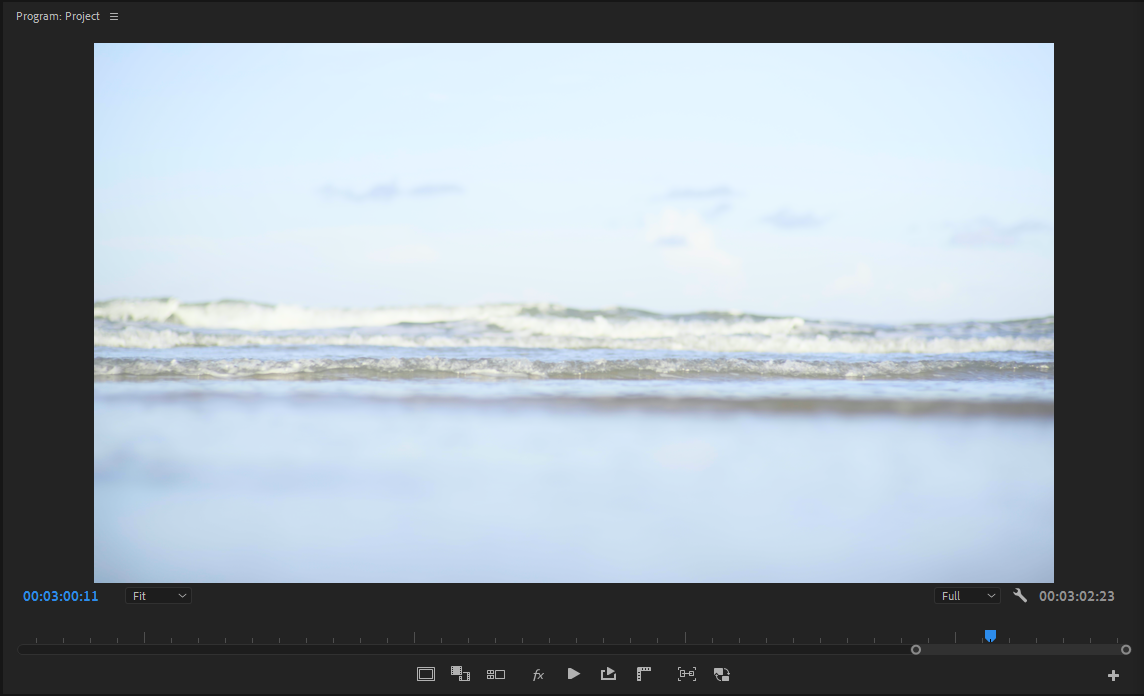
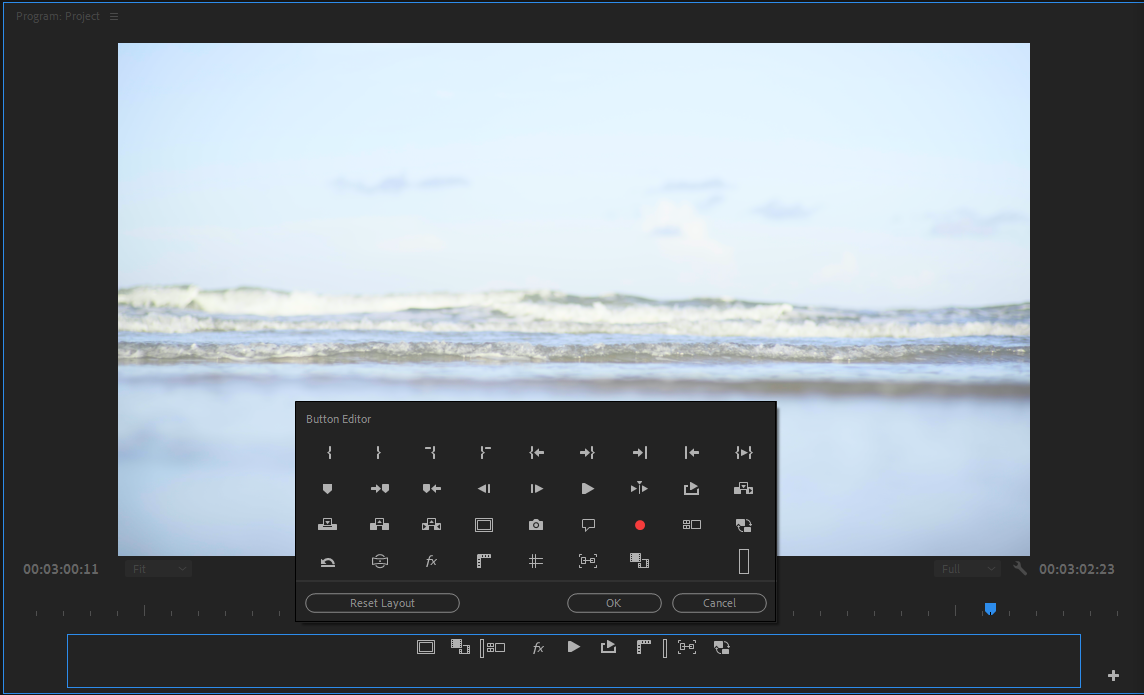
If y'all don't come across this button, it'southward very easy to add to your UI. Only click the "+" icon in the lower correct of the window, observe the push, and click to add. Also take the time to explore some of the other buttons in the menu if y'all've never done then before. Alternatively, you can create a keyboard shortcut.
While you're in the Program Monitor, click the wrench icon and find the choice for "High Quality Playback." This option provides a slightly crisper prototype in the Program Monitor, though the visual improvement is frequently negligible without huge screens. That's why I recommend unchecking this choice, as the performance hit is commonly not worth information technology.
Lower the Resolution and Use Proxies
Now permit's talk resolution. If you're attempting to cut 8K raw media on a laptop, in that location's your problem. Very few machines can handle that many pixels smoothly, so don't feel bad if yous need to utilize a proxy workflow. In fact, near Hollywood workflows nevertheless cut with proxies, considering it's so much faster, especially for remote workflows.
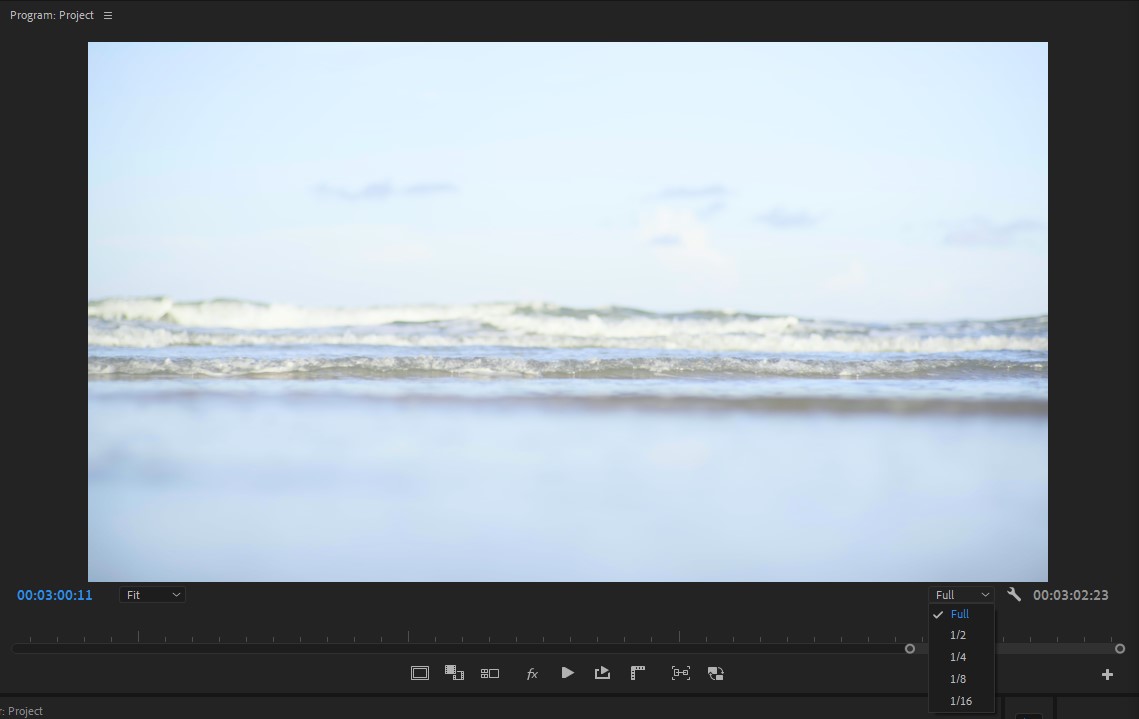
But sometimes proxies aren't enough, and you need to become a step further. You can also salvage some processing ability by lowering your playback resolution in the Plan Monitor. The frame size of your current sequence will determine what options are bachelor in the window's dropdown menu, simply half or a quarter is generally acceptable for assembling your edit or fine-tuning a scene.
Switch Codecs
Across resolution, codecs tin can exist a prime culprit of choppy playback. Some codecs, like H.264-based files and flavors of .MXF are very processor intensive due to their use of inter-frame pinch. These codecs are by and large bang-up as a delivery format, just terrible for editing. So if time permits, transcoding your media to an intra-frame codec similar ProRes can really speed your editing forth.
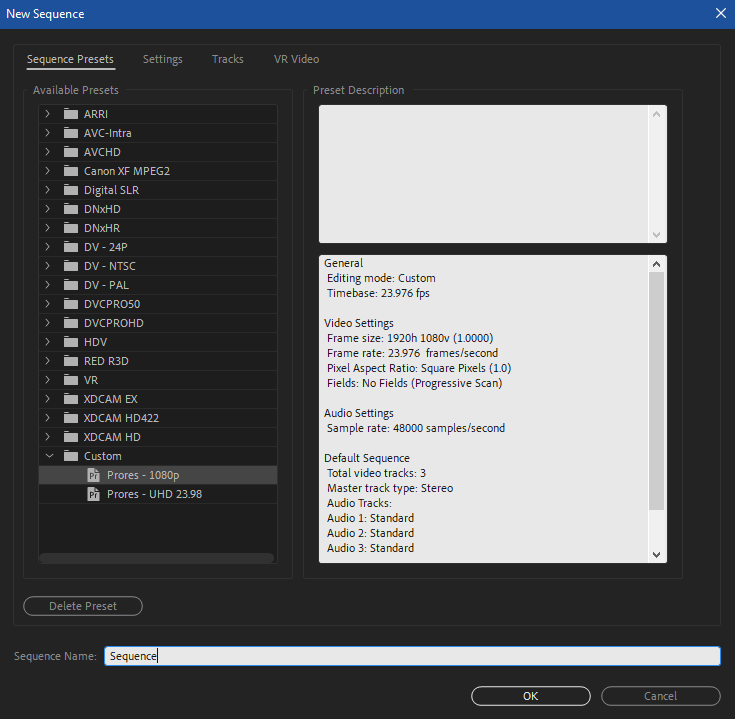
If yous're guilty of right-clicking "new sequence from clip" in the project window so editing your project in that sequence, and so your sequence could be defaulting to some less-than-helpful settings. So, I encourage you to dig a little deeper into the sequence settings to make sure yous're editing media in a quality intra-frame codec, and that your sequence is creating previews files in the same or similar codec.

For example, I commonly use QuickTime as the preview file format with Apple ProRes 422 every bit the codec. If you desire (and this is a potent recommendation) you tin can create a custom sequence preset with the settings you need, and then you don't have to manually change them for every new sequence.
Articulate the Cache
Lastly, choppy playback in Premiere could exist acquired past bad render files and/or enshroud files. If the above solutions haven't solved your playback woes, it may help to clear these files.
Clearing your sequence'south render files is pretty easy. But open up the Sequence dropdown carte du jour on the program bar and click "Delete Render Files."
With Adobe's latest 2020 release, it is now much simpler to articulate Premiere's cache. All you have to exercise is open Premiere's preferences and select the "Media Enshroud" tab, and then click the new "Delete" button side by side to "Remove Media Cache Files".
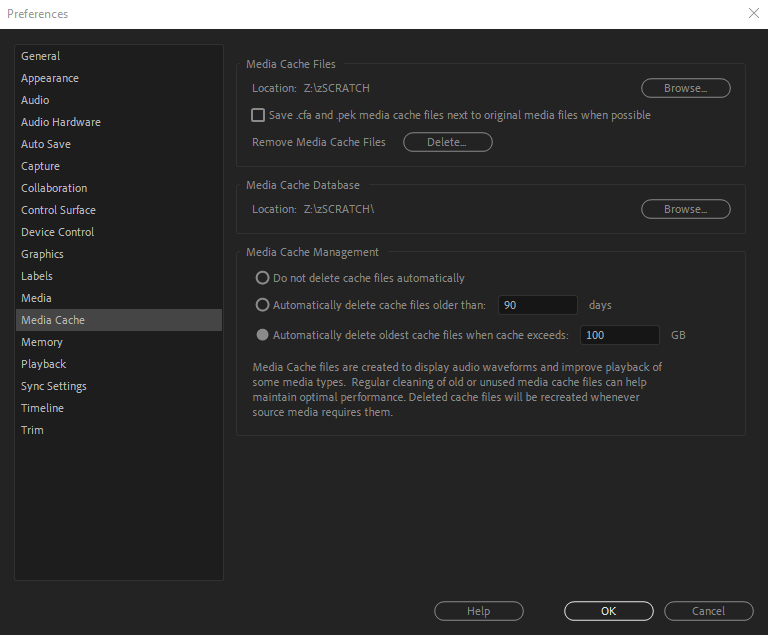
From here you'll take two options.
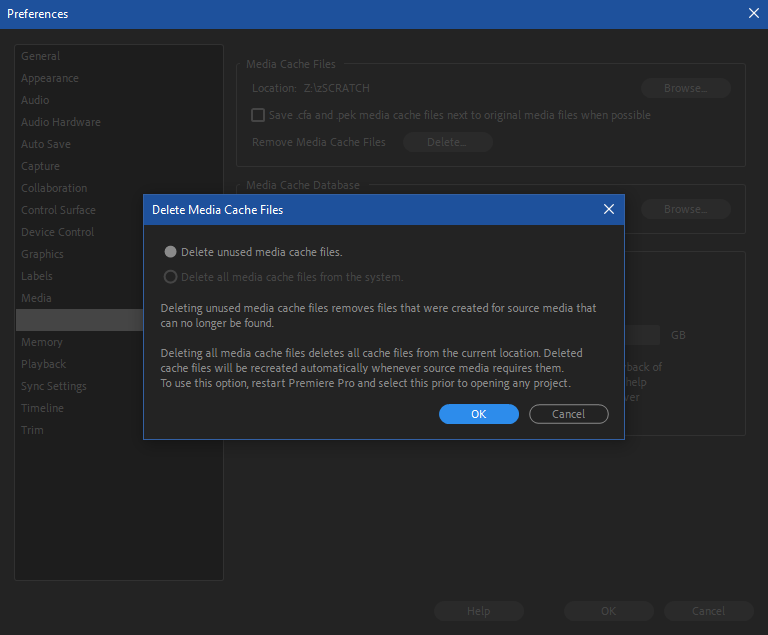
The first, "Delete Unused Media Cache Files" clears all unused cache files in relation to the projection you currently have open. The second choice can simply be selected subsequently restarting Premiere without any projects open. It clears the entire cache.
If you lot prefer the older easily-on approach of clearing the cache, take a stroll into your project's media cache folder and delete the files manually.
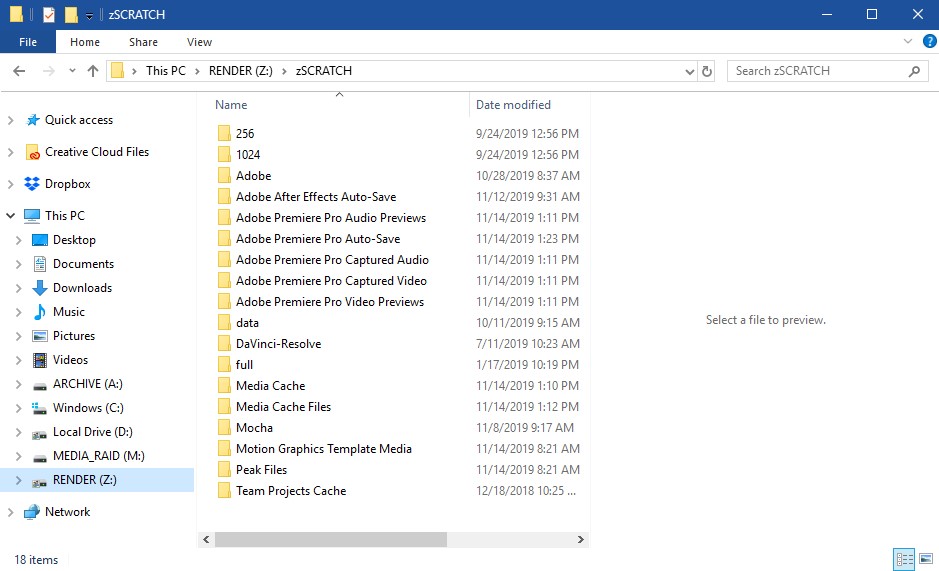
Yous tin delete the folders "Media Enshroud" and "Media Cache Files" entirely to really make sure your cache clears. Don't worry, Premiere will rebuild them.
Stuttering Clips
Now let's imagine you're trouble is a little bit different than inclement playback beyond a whole project.
Sometimes you lot might feel similar a clip y'all've practical a speed ramp to pops or stutters during playback. Or that a sequence with footage of mixed frame rates has sure clips that experience the aforementioned upshot.
In both instances, this type of prune-specific stuttering is acquired by how Premiere is interpolating the footage, rather than a performance consequence rooted in your hardware.
Interpolation is the method for how Premiere handles playback of a clip at a different framerate than the actual number of frames per second it was recorded in. These methods usually involve the cosmos of "missing" frames necessary for a time-remapped clip or mismatched frame rates.
For example, if you time remap a clip from 100% to 50%, the clip length doubles, but where do those extra frames come from? That's the work of interpolation.
Mixing frame rates in a sequence is frequently a necessary evil, especially in documentary work. Say y'all plan to deliver in 23.98fps, but 1/3 of your media is 29.97fps. Dropping a 29.97fps prune into a 23.98fps sequence volition often generate a slight jitter that's most noticeable in clips with movement.
Step back and retrieve about what'south happening. Premiere is taking a i 2d 29.97fps prune and squeezing it into a 1 second slot in a 23.98fps sequence. That'south basically half dozen extra frames per second Premiere has to interpolate. Aside from trying alternative interpolation options, there's non much that tin be done to fix this inside of Premiere. Depending on the severity of the jitter, it may exist in your best interest to use a hardware converter, similar the Blackmagic Teranex, to conform the clip(southward) from 29.97fps to 23.98fps.
Interpolation is also used when fourth dimension remapping clips. Adobe Premiere offers three interpolation options: frame sampling, frame blending, and optical flow.
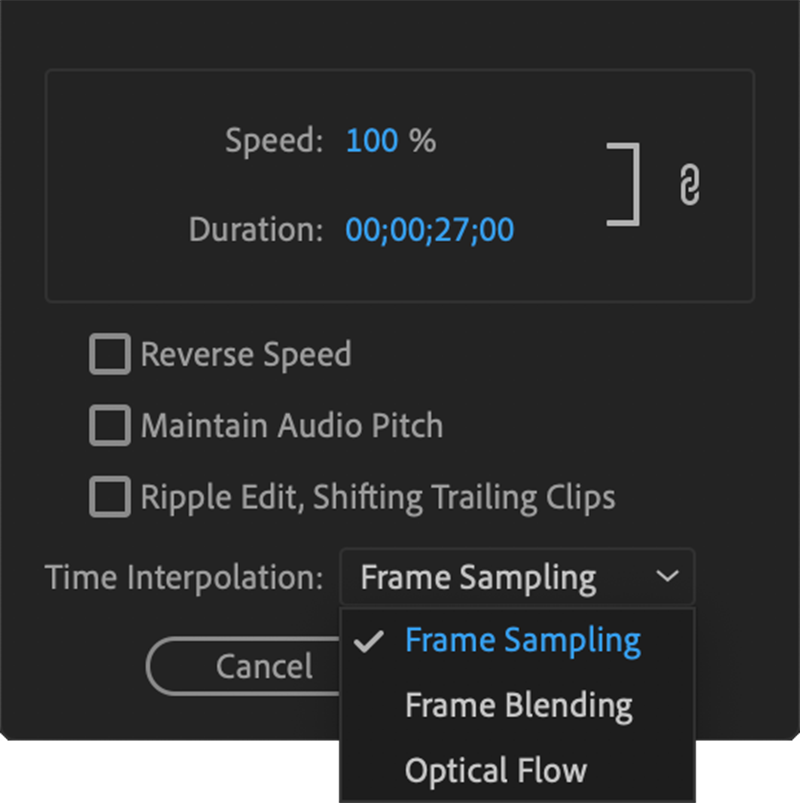
Frame sampling duplicates a frame to make up for missing frames, frame blending blends two frames together to create a new frame, and optical flow uses complex math to make a best approximate at what the missing frame should expect like based off pixel data from inside the image.
Each method offers a different look/consequence and tin can be used to aid reduce the popping or stutter of a remapped clip. Unfortunately, that is not enough, especially when slowing a prune down substantially.
Proper speed ramping usually forces us to do some pre-planning when shooting video, which sometimes even includes math. Shooting at high frame rates allows editors to slow down footage in post and helps avoid the stuttery look. Understandably, there are many situations when the verbal speed of a time remapped prune won't exist determined until in the edit, simply y'all'll need to do your best if you're involved with production of the projection.
Pretend we're working on a projection, planning to deliver in 24fps and shooting in 60fps. For our clips to play back buttery-smooth in a 24fps sequence, we need to know the precise speed to play back each of the 60fps clips so that there is only one frame for every 24th of a second. So, 24 frames per second of playback divided past threescore frames per second of footage, leaves us with 40% speed. That means slowing each 60fps clip down to 40% speed volition plow those clips into smooth, irksome-motion 24fps clips.
If math isn't your matter or you merely desire Premiere to do the piece of work, yous can as well select the 60fps clips in the Project panel, right click "Change" and nether the "Translate Footage" tab select "Assume this frame rate:" and type 24fps.
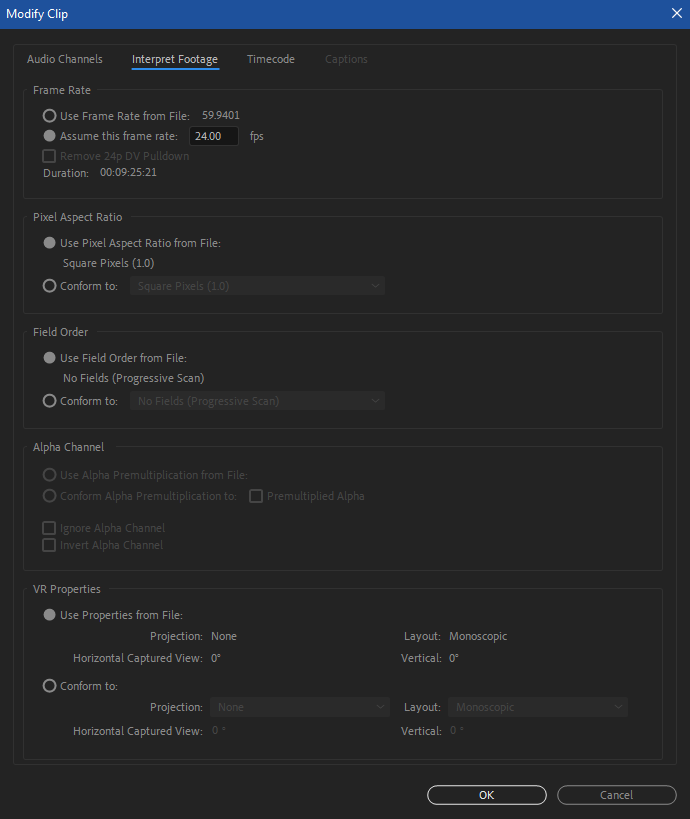
In one case you click ok, Premiere will do all the math for you and every clip in the sequence will playback at 24fps. Note you lot should exercise this prior to adding clips to whatever timelines every bit this plainly changes the clip's timing.
Slow Preview Rendering
Despite our all-time efforts, rendering is sometimes the just mode to play back a sequence or parts of a sequence in existent-time. And depending on what's going on in a sequence, this can too take a while. Outside of the corporeality of sheer processing ability bachelor to your system, the resolution, codec, and corporeality of effects in your sequence weigh most heavily on this event.
One selection that may save time is to adjust the video preview settings of your sequence. In your Sequence Settings, the option to change preview size only affects the previews you're seeing inside of Premiere and non the concluding export.
So if your sequence frame size is 3840×2160, setting the video preview size to 960×540 drastically reduces the size of the preview files Premiere has to create, which obviously means they take less time. And unless y'all're relying on defended preview monitor, you lot may not notice a huge quality difference in your Program Monitor.
No Video Preview In Program Monitor
If you've been editing along swimmingly and suddenly the Program Monitor just shows black while playing back a sequence there'due south a good risk the GPU or a bad render/preview file is to blame.
GPU issues sometimes occur when using CUDA or Metal-based renderers, and so about oftentimes happen when stacking effects on high resolution video. As powerful as these cards are, they sometimes hitting a snag with intensive workflows.
Normally a programme or computer restart addresses the consequence, but occasionally they can persist when a certain part of a sequence with heavy furnishings will ever cause the Program Monitor to become black. If you feel this try changing the renderer in your projection settings (File > Project Settings > General…) to utilise Software-Just rendering. This option takes your GPU out of the equation.
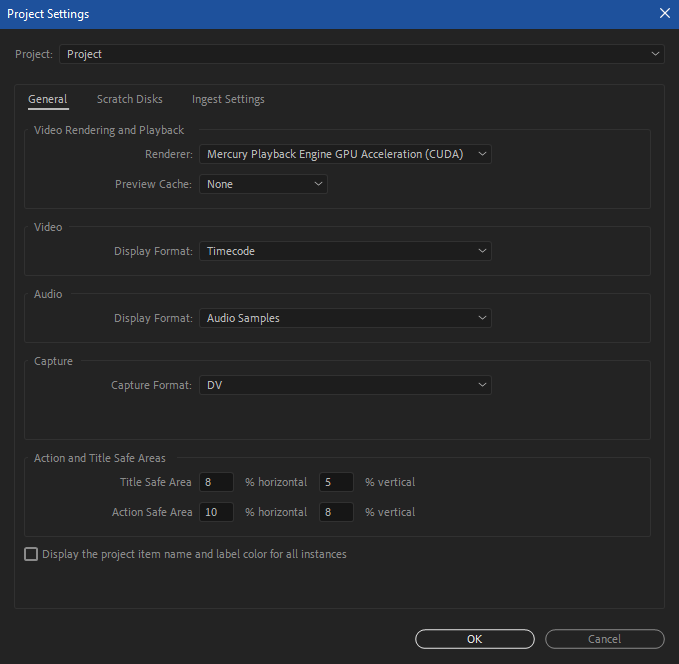
This will nigh certainly cause a noticeable performance hit, but y'all can work similar this in a pinch. You can also marker In/Out on the troubled section of video, render it In to Out, and and then export that section of your sequence using preview files in a practiced codec. By cut this "pre-rendered" chunk back into your sequence on top of the layers that were used to create it, you lot tin can keep your GPU rendering on without the monitor going black.
Another option to fix lack of video in the Program Monitor is to try clearing the renders/preview cache like we explored earlier.
Audio Won't Play or Drops Out
Chances are that, if audio playback is choppy or not playing at all just Premiere otherwise seems to exist working fine, then your hardware settings take inverse. These settings are system dependent and can be adapted in Preferences > Audio Hardware. Pay careful attending to the Default Output pick as it isn't necessarily the aforementioned as the system's default output.
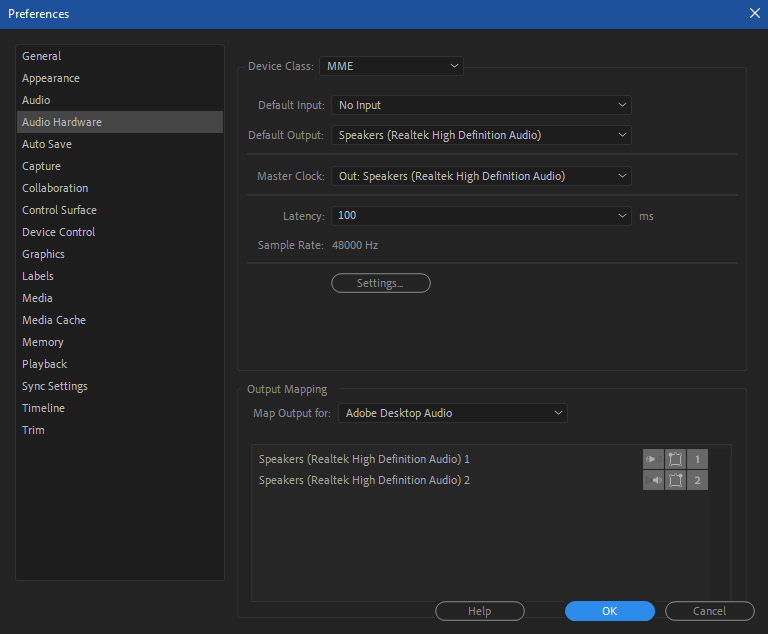
If audio is dropping out as yous playback a sequence, that could be due to latency or using compressed audio.
Latency is the short delay that'south experienced when an audio signal is processed by a computer and then output to the speakers. You lot can adjust latency in the Sound Hardware preferences, and so requite that a try if necessary. Smaller values offer lower latency, simply higher values tin can sometimes alleviate sound dropouts.
Premiere can by and large handle whatever you throw at it, but some systems may occasionally experience sound dropouts with compressed audio files, like MP3s. The best way to avoid this is to either use an uncompressed audio file, similar .WAV or .AIF, which are easy to convert to.
Common Export Bug
Now allow's imagine some other problem. You've finished editing your project, just you tin't get the blasted thing to export correctly. Allow's take a look.
Error Messages Defined
Sometimes Premiere will do you lot a favor and spit out an error code well-nigh an result. These letters do a decent, admitting still frustratingly inconsistent, task of titling errors in a meaningful way (at least for export/render issues).
If you don't know what an error really ways, just consult the list to get to the lesser of information technology.
Just let's presume you didn't get a clear error message. Here are some common causes for export issues in Premiere Pro
The Usual Suspects
As we've already covered, the most common functioning issues revolve around codecs, GPU processing, write locations, effects, and corrupt media. Likewise, export errors involve the same sorts of things. Nosotros've already covered codecs pretty well, and then let's leap dorsum to GPUs.
GPU Rendering
If you think the GPU is causing your exports to fail (similar it tin can with render previews), then try disabling hardware render settings in your project'south return setting. Again, software-just rendering volition exist slower, only it may permit you to export the sequence without failure.
Write Location and Permissions
Write location issues by and large stem from non having enough infinite available on a drive to write to the file. But they can too involve permission mismatches. Plainly, the simple solution to the onetime is but to make sure you have enough space bachelor at the write location prior to exporting.
Permission problems can be especially prevalent in networked environments. (They tin pop up on solo machines too.) They can be a real pain to solve if you've never encountered them before. The verbal cause and solution of these problems is dependent on a number of factors, and are a bit more granular than we'll cover here, but there are lots of resources out at that place for solving common Mac and Windows permissions bug.
Troublesome Effects, Again
Too many effects can give u.s.a. a lot more than grief beyond just choppy playback. If your exports are failing, it'due south possible there'southward a troublesome upshot hiding in your timeline.
It'due south easy to test this. Turn on the "Global FX Mute" choice and endeavour to export your sequence. If it exports fine without effects, then there'southward a problematic result or corrupt slice of media amongst your clips.
Just at the finish of the day, yous probably demand the furnishings on your timeline. So you need to notice it and fix it.
And so disable "Global FX Mute," and mark an in point at the outset of the sequence and an out signal in the eye of the timeline. Now endeavour to export that portion.
If it works, then y'all know the troublesome effect is non in the first half of your sequence. Now test the second half. And then make an in bespeak in the middle of your sequence and an out point at the end. If it fails to export here, yous know the bad result is in that half (though you probably already knew that since the first half exported fine, this simply confirms it).
Now it'south time to hone in on the bad issue, so repeat this procedure again by exporting half of the failed in/out points. If information technology exports fine, the bad effect is in the concluding quarter of your timeline, and if it fails, you're closer to finding information technology. You lot get the thought.
Once you've plant the problematic clip or upshot, render information technology and export information technology individually, both with and without effects. In one case you have a rendered file of the troublesome prune, just import information technology into your timeline and insert it higher up the offending clip (which you may need to disable). Now y'all should be able to export your timeline without any bug.
Nuclear Options
Unfortunately, there are times when technology will get the all-time of us and we are left with uncomfortable choices.
Nosotros're fortunate equally video editors that this isn't life and death – simply lost time and productivity. Simply it's a hard choice nonetheless if you're approaching deadline and Premiere still has performance issues.
For times such as these, here are the last, nuclear options to consider.
Clear Premiere Pro's Preferences And Plugins
Resetting Premiere Pro back to its original country may be the cure for your ills. Of course, trashing all your preferences and customizations is painful, just information technology may be your only option.
But before you reset Premiere Pro, first try immigration the plugin cache. Plugins are great, but sometimes they don't play overnice with the latest update. Or they develop bugs of their ain. To clear their cache, hold Shift+Alt (Windows) or Shift+Option (Mac) while launching Premiere until the splash screen appears. And if this doesn't work, try removing and re-adding plugins to Premiere.
Merely if that still doesn't piece of work, it'southward time to reset Premiere's preferences entirely. Hold Alt (Windows) or Selection (Mac) while launching Premiere until the splash screen appears. Prayers are optional in this step.
When All Else Fails
If none of the above has solved your Premiere Pro playback issues, I apologize and mourn your situation. At this betoken, your only option may be to uninstall and reinstall Premiere Pro. It sucks, merely sometimes years-erstwhile installs demand a fresh kickoff. Make sure all your projects are saved and backed upwardly externally. Then employ the Creative Deject desktop app to remove and perform a clean install of Premiere Pro.
If later on this final cease y'all're nevertheless having performance bugs, it'due south likely you have a deeper hardware or workflow issue. Information technology's time to call in an expert to await at your situation. Godspeed.
The Route to Recovery
Solving technical issues can be a painful process. Information technology'southward confusing, confusing, and sometimes mind-numbingly slow. When a client or producer is breathing down your cervix to cease a project, information technology's massively stressful.
But at the cease of the day, it'due south our chore to keep our tools in shipshape. We demand to take charge of our workflows and equip ourselves with the knowledge to fix our own bug. If we can do that, we'll feel more comfortable with our applied science and more than confident in our abilities. Plus, showing off a piddling technical prowess can definitely impress clients and coworkers. And that can inspire them to piece of work with you down the road.
Now you should be ready to tackle some of the most common issues yous're likely to face in Premiere Pro. Then get along and conquer those workflow bugs!
Choppy playback isn't the simply effect with Premiere Pro. Are there any common bug we left out? Let u.s. know in the comments, and share your solutions with the customs. We beloved hearing from our readers, and learning from your incredible creativity and feel.
Source: https://blog.frame.io/2019/11/18/diagnosing-premiere-pro-problems-choppy-playback/
0 Response to "When I Upload a Video in Premiere the Video Lags From the Audio"
Post a Comment